Brazilian poultry: what can we expect for 2023?
18/01/2023
Modern industrial poultry production has achieved extraordinary levels of productivity thanks to advances in genetics, nutrition, management, health, and automation. However, this evolution has also been accompanied by increasing microbiological pressure on production systems, growing concerns about food safety, and the need to reduce the use of antimicrobials as a tool for disease control. In this context, gut health has taken a central position in sustainable production strategies, moving beyond being merely a factor related to zootechnical performance to becoming one of the pillars of biosecurity and One Health programs.
For many years, the intestinal microbiota was considered merely an inevitable consequence of the environment to which birds are exposed after hatching. Today, however, it is understood that its development represents a highly organized biological process, influenced by the sequence and timing with which different microbial groups colonize the gastrointestinal tract. More than simply the presence of beneficial bacteria, what determines the balance of the intestinal ecosystem is how these populations become established, interact, and occupy the ecological niches available during the first hours of life.
From this perspective, intestinal colonization is no longer interpreted exclusively from a microbiological standpoint and is instead understood as a process of microbial ecological succession
As occurs in any natural ecosystem, the pioneer community progressively modifies the environment, conditioning the establishment of populations that emerge later. This sequence of events determines the ecological trajectory of the microbiota, influencing its stability, functional diversity, and ability to resist colonization by undesirable microorganisms.
The first hours after hatching represent a biological window of enormous relevance. During this period, the gastrointestinal tract exhibits high ecological plasticity, characterized by the broad availability of niches, limited microbial competition, and low ecological resistance to invasion.
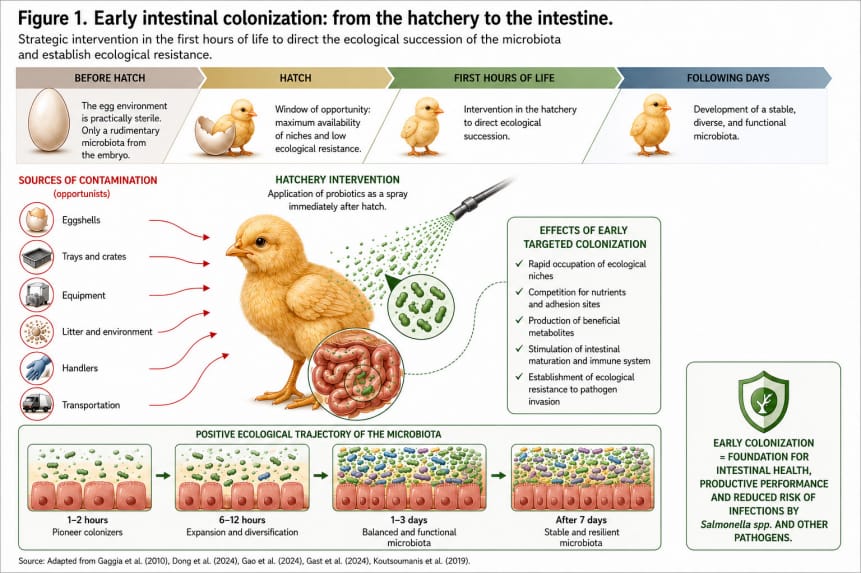
The first colonizers exert a disproportionate influence on the entire community that will subsequently develop, a phenomenon known as “priority effects.” Small interventions carried out during this period can profoundly modify the subsequent development of the microbiota, producing effects that persist throughout the production cycle. The main concepts related to microbial ecological succession during early intestinal colonization are summarized in Figure 1.
A properly established pioneer microbiota promotes the rapid occupation of available ecological niches, reduces resource availability for opportunistic populations, and favors the development of so-called “colonization resistance,” or ecological resistance to invasion. This represents one of the most important natural mechanisms for maintaining the stability of the intestinal ecosystem, limiting the establishment of potentially pathogenic microorganisms and increasing the resilience of the microbial community in response to the constant changes imposed by the production environment.
This new understanding profoundly changes the way the use of probiotic cultures in poultry production is interpreted. The objective is no longer simply to add beneficial bacteria to the birds’ intestines. Instead, the intervention aims to direct the ecological succession of the microbiota, deliberately guiding the development of a more stable, functional, and resilient intestinal ecosystem capable of withstanding health challenges. In other words, this represents an ecological engineering strategy applied to animal production.
Within this new paradigm, the hatchery assumes a much broader role than traditionally assigned to it.
For decades, this environment was regarded essentially as a unit for incubation, vaccination, and chick processing. Today, however, it can be understood as the first controllable microbial ecosystem in a bird’s life. It is in this environment that the first real opportunity exists to deliberately and consistently influence the ecological trajectory of the intestinal microbiota.
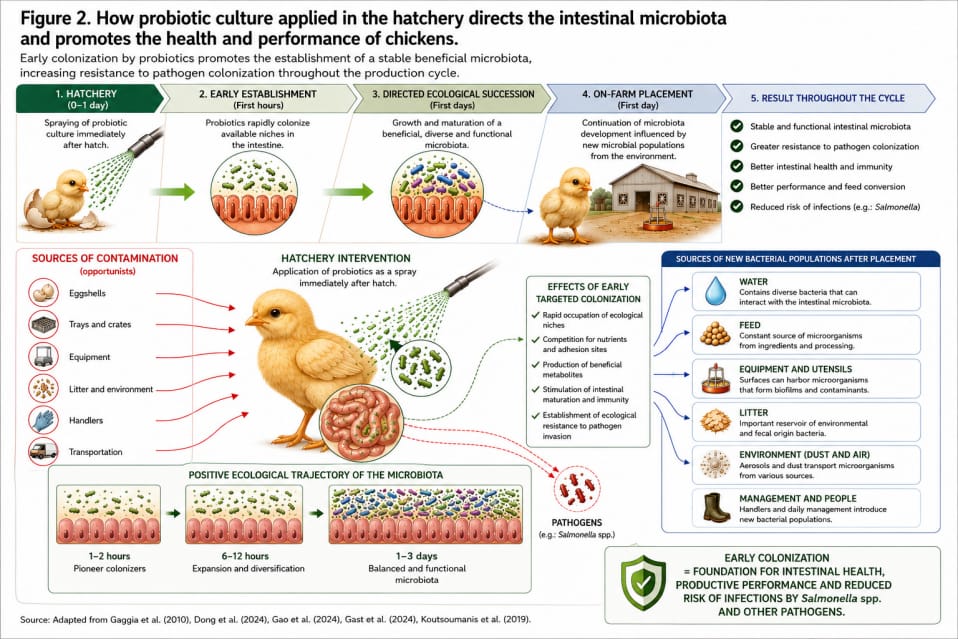
Immediately after hatching, chicks come into contact with a wide diversity of microorganisms present on eggshells, trays, equipment, dust, transport boxes, handlers, and throughout the hatchery environment itself. In the absence of a targeted microbiological strategy, initial colonization occurs predominantly in an opportunistic manner, allowing ecological niches to be occupied by populations whose composition depends much more on environmental conditions than on their functional potential for the host.
Early intestinal colonization seeks to replace this random process with a planned ecological succession. Through the administration of carefully selected microbial communities, the aim is to rapidly establish populations capable of occupying the main intestinal niches before undesirable microorganisms become established. The earlier these communities are established, the greater their potential influence on the organization of the intestinal ecosystem and on the development of the populations that will subsequently succeed them. Figure 2 illustrates how the application of probiotic cultures in the hatchery, immediately after hatching, directs the ecological succession of the microbiota, promoting the early occupation of intestinal niches and positively modulating bird development throughout the production cycle.
From this perspective, hatchery-based application strategies offer highly relevant operational and biological advantages
Among these, the spraying of probiotic cultures immediately after hatching stands out as the most widely adopted technique in commercial poultry production. In addition to enabling highly uniform distribution, this approach coincides with a period of intense exploratory activity in chicks, characterized by their natural preening behavior and continuous ingestion of particles present in the environment, thereby facilitating the early acquisition of the applied microorganisms.
In recent years, another approach has attracted growing interest: the application of microbial cultures while the eggs are still inside the setters and the chicks remain in the hatchers. Under these conditions, thousands of chicks are confined within a relatively small environment, with intense movement, constant physical contact, and high circulation of suspended particles. This scenario favors widespread dissemination of microorganisms across the feathers, skin, beaks, and equipment surfaces, significantly increasing opportunities for colonization even before the chicks are removed from the hatchery.
This strategy also offers an important advantage: it can be easily integrated into the established operational workflow, allowing large populations of newly hatched birds to be simultaneously exposed to the bacterial cultures, with a high degree of standardization and without interfering with routine hatchery operations. More than a simple application technique, it represents an opportunity to direct, from the earliest moments of life, the development of an intestinal ecosystem capable of supporting the birds throughout their entire production cycle.
The effectiveness of this strategy, however, does not depend exclusively on the timing of application. The microbiological quality of the cultures used is a determining factor in the success of directed colonization. The strains must exhibit a high capacity to adapt to the intestinal environment of birds, rapid establishment, stability throughout the application process, and the ability to act cooperatively in the development of a functional microbial community.
As this pioneer community becomes established, intense interactions between the microbiota and the host begin to take place. Colonizing microorganisms contribute to the maturation of the intestinal epithelium, strengthen cellular junctions, stimulate the production of mucins and antimicrobial peptides, and support the development of gut-associated lymphoid tissue (GALT), contributing to more effective immune responses.
From this perspective, early colonization can be understood as a form of “ecological vaccination” of the gastrointestinal tract.
This is a conceptual analogy: while vaccination prepares the organism to recognize specific antigens, directed colonization establishes an ecosystem capable of continuously modulating intestinal development, strengthening natural defense barriers, and increasing the biological resilience of birds.
Among the health challenges faced by the poultry industry, Salmonella spp. occupies a prominent position. Early occupation of ecological niches, competition for nutrients, and the metabolic activity of a balanced microbiota strengthen colonization resistance, reducing opportunities for the establishment and persistence of this pathogen. Although it does not replace biosecurity, vaccination, and monitoring, early colonization serves as an essential tool within integrated control programs.
We know that microbial ecological succession begins even before hatching. Egg microbiological quality, the laying environment, and, particularly, the intestinal health of breeder hens influences the initial conditions for microbiota development in their offspring. Thus, the hatchery represents the primary operational point for intervention, but not the beginning of the biological process; rather, it represents a continuation of a process that has already begun.
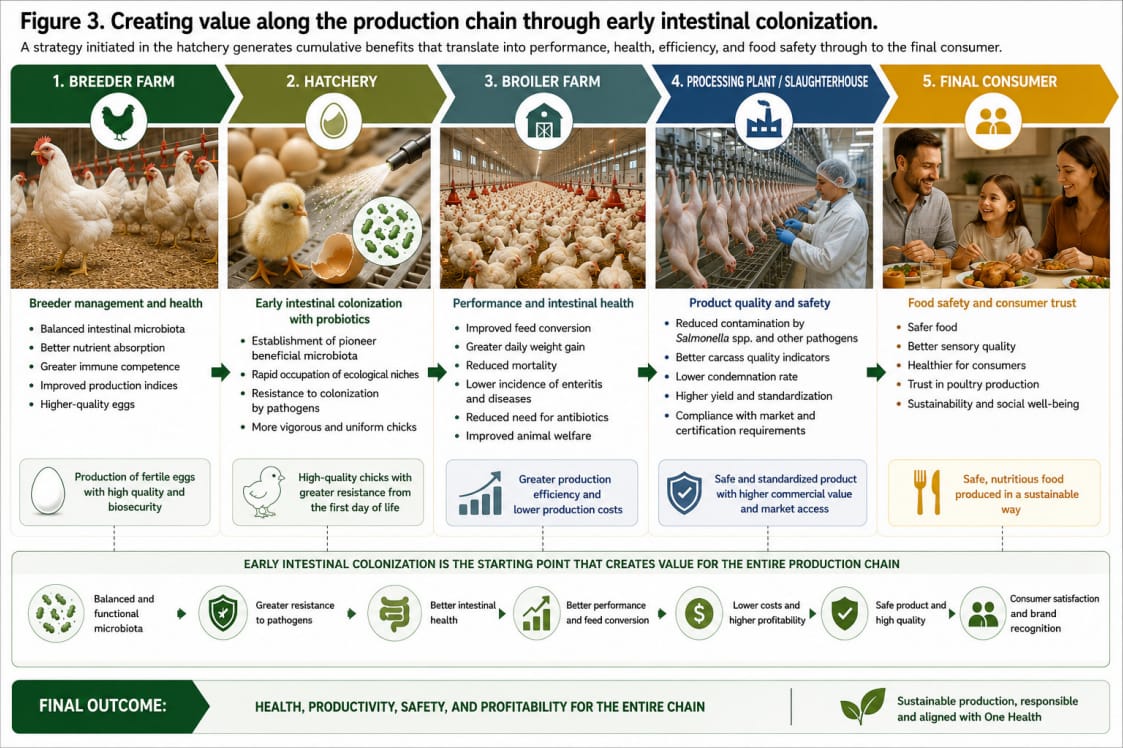
By contributing to Salmonella control, supporting the judicious reduction of antimicrobial use, and strengthening sustainable food production, early colonization is fully aligned with the principles of One Health. The biological effects of early intestinal colonization reverberate throughout the entire poultry production chain, from breeder farms to the final consumer, as summarized in Figure 3.
In this way, we understand intestinal colonization as a process of ecological succession, representing a paradigm shift. The focus is no longer exclusively on the administration of probiotics, but rather on the planned guidance of the development of a functional intestinal ecosystem. The hatchery is consolidated as the first controllable microbial ecosystem in a bird’s life and as one of the most strategic and high-potential points for influencing its future ecological trajectory.
By directing ecological succession from the breeder farms and consolidating it in the hatchery, this technology establishes biological foundations capable of supporting the birds throughout their entire production cycle, contributing to poultry production systems that are more efficient, resilient, and aligned with the challenges of modern poultry production.

Author: Ricardo Ito
Technical Manager